

In short: Mark Post helped turn cultivated beef from a lab idea into something people could see, cook, and eat. On 5 August 2013, he showed the first cultivated beef burger in London. It cost about £215,000, used around 20,000 lab-grown muscle strands, and proved that meat could be made from animal cells without slaughtering a whole cow.
If you want the main points fast, here they are:
- Who: Professor Mark Post of Maastricht University
- What: The first public tasting of a cultivated beef burger
- When: 5 August 2013
- Cost: About £215,000
- How: Muscle stem cells from a cow biopsy were grown into tissue strips
- Scale: Around 20,000 strips were pressed into one burger
- What it showed: Cultivated beef could be made and eaten
- What it did not solve: Price, mass production, lipid composition, and animal-free growth media
- What came next: Post later co-founded Mosa Meat in October 2015
What stands out to me is this: the burger did not fix the hard parts, but it changed the question. Before 2013, many people asked, “Can this be done at all?” After the tasting, the question became, “How can this be made at scale and at lower cost?”
| Point | Detail |
|---|---|
| Public debut | 5 August 2013, London |
| Lead scientist | Mark Post |
| University | Maastricht University |
| Funding support | €250,000 from Sergey Brin |
| Burger cost | £215,000 |
| Burger weight | 142 g |
| Tissue used | About 20,000 muscle strands |
| Main limit | No fat; use of FBS |
| Business next step | Mosa Meat, founded in 2015 |
I see this story as a shift from lab research to public proof. It showed that cultivated beef was not just theory any more - it was food on a plate, even if the product was still far from supermarket shelves.
Launch of the world's first cultured meat hamburger (August 5, 2013)
sbb-itb-c323ed3
Mark Post's early research at Maastricht University
The 2013 burger didn't come out of nowhere. It was built on years of tissue engineering work at Maastricht University.
Mark Post is a Dutch pharmacologist and Professor of Vascular Physiology at Maastricht University.[2] Before turning to food, he worked in medical tissue engineering, including growing blood vessels from cells.[6] Later, he took those same methods and applied them to meat.
He joined a Dutch government-funded programme in 2008, kept the work going after public funding ended in 2009, and later secured €250,000 from Google co-founder Sergey Brin to finance the first Cultivated Meat burger.[2][3]
That money gave the project enough time to keep moving and find out whether Cultivated Meat could help with a serious food-system issue.
The problem he set out to address
Post viewed conventional beef as resource-intensive and hard to sustain at scale.[7]
"Right now, we are using 70 per cent of all our agricultural capacity to grow meat through livestock. You are going to need alternatives. If we don't do anything, meat will become a luxury food and will become very expensive." - Mark Post, Maastricht University[7]
With global meat demand projected to double by 2050, he saw the challenge as urgent.[7] His goal was simple in theory, even if difficult in practice: produce real beef from animal cells, keep the meat people already want to eat, and cut the resource load linked to livestock production.
Why beef was the focus
Post chose beef on purpose because he saw it as the biggest threat to food security and the environment.[4][6] Compared with conventional cattle farming, Cultivated Meat could use 99% less land and produce 96% fewer greenhouse gas emissions.[5]
"We're focusing on beef, because that's the biggest threat to food security and the environment." - Mark Post, CSO, Mosa Meat[4]
So beef became the test case. If Cultivated Meat could work there, it could take on one of the hardest and most high-impact parts of the food system.
How the first cultivated beef burger was made
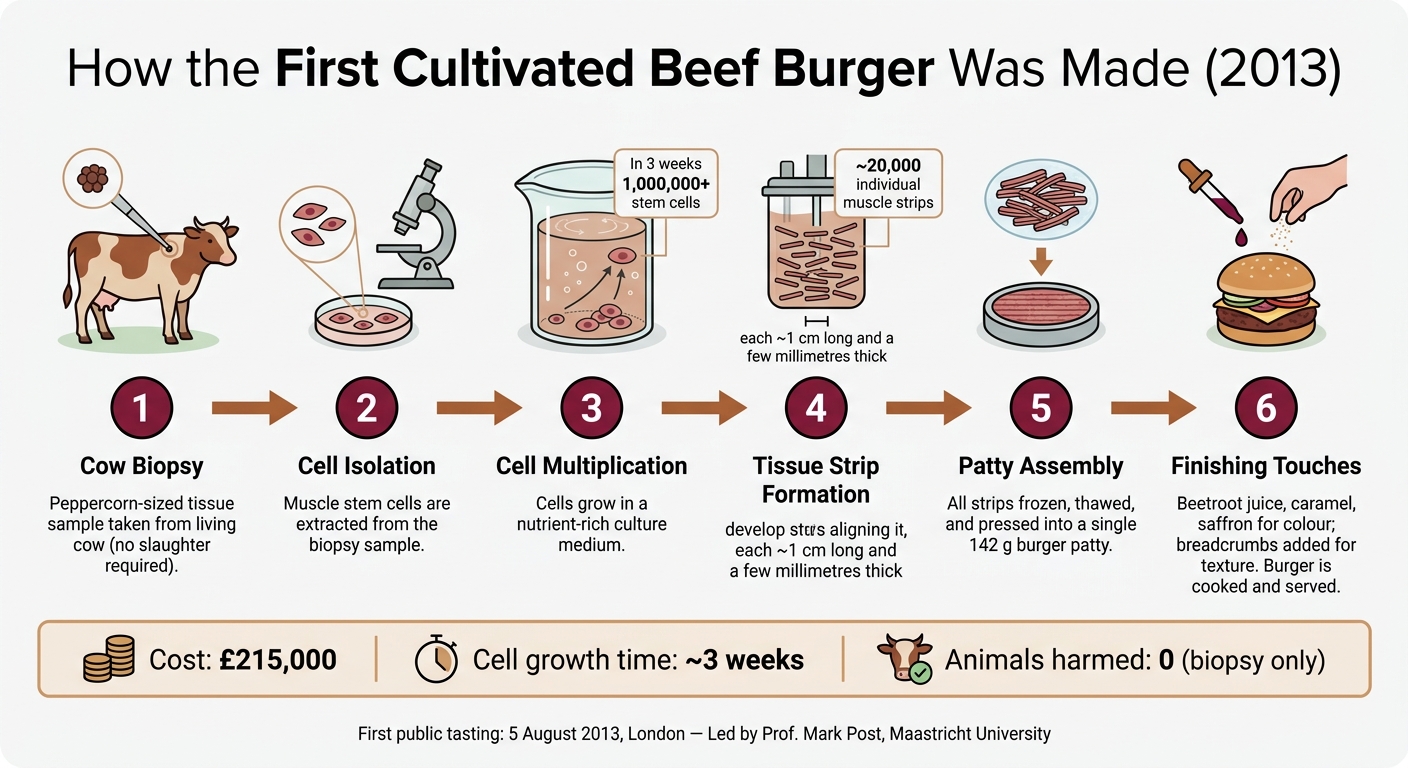
How the First Cultivated Beef Burger Was Made (2013)
From cow biopsy to burger patty
That idea turned into a real product through a tissue-engineering process that was simple in concept, but slow and exact in practice. It started with a peppercorn-sized biopsy from a living cow [11]. Scientists took muscle stem cells from that sample and placed them in a nutrient-rich culture medium, where the cells were encouraged to multiply. In just three weeks, that tiny piece of tissue grew into more than one million stem cells [5].
The team then moved those cells into dishes, where they developed into strips of muscle tissue about 1 cm long and a few millimetres thick [5][9]. To make a 142 g burger patty, they had to grow 20,000 muscle strands [8][9]. Those strands were then frozen, thawed, and pressed together into a patty for the tasting event [5].
To make it look and feel more like beef, the team added beetroot juice, caramel, and saffron for colour, along with breadcrumbs to address taste and texture challenges [5][9].
What the project proved at that stage
The burger wasn't made to fix cost or mass production. Its job was to show that the cells could be turned into edible meat. And on that point, the project worked: it showed that Cultivated Meat could be grown, cooked, and eaten.
Josh Schonwald said:
"The mouthfeel is like meat. I miss the fat, there's a leanness to it, but the general bite feels like a hamburger." - Josh Schonwald, Food Writer [12]
That leanness came from a clear limit in the recipe. The burger had no fat cells, and it still depended on animal-derived growth medium [11][4]. That's why it drew so much attention at the time: it proved the idea, but it wasn't yet a finished product.
The 2013 public unveiling and its limits
Why the televised tasting made global news
Once the burger existed, it had to face the public. In August 2013, Mark Post stood in London while chef Richard McGeown cooked the burger, and Hanni Ruetzler and Josh Schonwald tasted it on camera. That moment marked a clear shift: Cultivated Meat moved from scientific theory to something people could actually see as food [11][14].
The event hit hard because it showed edible meat being cooked and eaten in plain view. This wasn't just a lab story any more. It was a proof-of-concept demonstration meant to show that meat grown from cells could be made without raising a whole animal, while also helping draw future funding [13].
What it proved and what remained unsolved
The burger cost about £215,000 because it was a proof of concept, not something built for sale. What it did show was simple but important: cow stem cells could be grown into edible muscle tissue and shaped into a patty people would recognise. As Hanni Ruetzler said:
"It's close to meat, but it's not that juicy. The consistency is perfect... This is meat to me." - Hanni Ruetzler, Food Researcher [12]
But the tasting didn't solve the hard part. It did not show that the product could be made at commercial scale. The burger had no fat, which left it dry and lean, and the process still depended on fetal bovine serum (FBS), so it was not yet fully animal-free [10][11][12].
So yes, the burger mattered. But it was a milestone, not the finish line on the cultivated meat roadmap.
Legacy: how Mark Post's burger shaped the consumer view of Cultivated Meat
From scientific milestone to public interest
The burger mattered because it gave people something concrete to picture when they heard about Cultivated Meat. Before that, the idea lived mostly in labs, papers, and expert circles. Once more than 200 journalists watched the unveiling, the field had a public reference point it has kept coming back to ever since [3][8].
That shift changed the conversation. It was no longer just about whether Cultivated Meat could be made at all. The focus moved to two tougher questions: can it be produced at scale, and can the price come down?
The original burger also gave the world a clear number to react to: about £215,000 in 2013. Post later said that cost could drop to roughly €10 per burger as production scales [3][4]. That kind of visibility turned a lab demonstration into a business question almost overnight.
Key takeaways from the case study
Mark Post showed that edible beef grown from cells was possible. The 2013 burger was a breakthrough in the literal sense: not a finished food product, but a public proof that the idea could work. That moment pushed Cultivated Meat into public view and set a benchmark that later progress would be measured against [1][3].
The next challenge was commercialisation. In October 2015, Post and food technologist Peter Verstrate founded Mosa Meat to turn that early work into a company [4].
FAQs
Why was the 2013 burger so expensive?
The 2013 burger cost £215,000 to produce because it was made at laboratory scale.
In plain terms, this wasn't a factory process. Technicians had to manually create around 20,000 muscle strands using standard tissue culture flasks, which meant repeating the same slow, skilled work thousands of times.
The price also reflected expensive laboratory supplies and the lack of the efficiencies you’d expect from modern industrial manufacturing.
Why did Mark Post focus on beef first?
Mark Post chose beef first because it’s one of the hardest parts of the food system to fix.
Beef puts heavy pressure on both global food security and the environment. So by starting there, his research went straight at some of the biggest problems: land use, greenhouse gas emissions, and the wider impact of industrial livestock farming.
What still needed fixing after the first tasting?
After the first tasting, Mark Post pointed to a few technical problems that still had to be solved.
The team still needed to work on:
- adding fat tissue to improve taste and mouthfeel
- replacing serum in the stem-cell growth process
- creating more complex 3D structures
- improving perfusion so nutrients could reach every part of the tissue


