

Cell line selection is the cornerstone of cultivated meat production, shaping its taste, texture, and overall quality. The right cells determine how closely cultivated meat can mimic conventional meat. Here's what you need to know:
- Muscle Satellite Cells: Provide the fibrous structure and protein content, influencing texture and "meaty" flavour. However, their growth is limited by the number of times they can divide.
- Mesenchymal Stem Cells (MSCs): Contribute fat and connective tissue, impacting flavour and tenderness. They grow faster than muscle cells but have limited longevity.
- Adipose-Derived Stem Cells (ADSCs): Specialise in fat production, crucial for juiciness and marbling. They can be tailored to produce specific fat profiles, like Wagyu beef.
- Fibroblasts: Versatile and abundant, these cells support structure through collagen and can transform into muscle or fat with the right techniques.
- Pluripotent Stem Cells (PSCs): Immortal and capable of forming any cell type, they offer scalability but are costly and complex to manage.
Each cell type plays a unique role in recreating the sensory experience of meat. Combining these cells allows producers to fine-tune taste, texture, and scalability. The choice of cell lines, their origin, and how they are cultured directly impact the final product's quality.
ICAN Webinar about Cell Lines and Culture Media for Cultivated Meat Applications

sbb-itb-c323ed3
1. Muscle Satellite Cells / Myoblasts
Muscle satellite cells (SCs) are one of the most well-established sources for cultivated meat production. These cells lie dormant alongside muscle fibres in living tissue, activating only when the muscle requires repair or growth. This natural role makes them particularly suited for replicating the fibrous texture of meat.
"Muscle satellite cells are among the most abundant tissue-resident adult stem cell populations, and their isolation from livestock and maintenance in vitro have been well established." - International Journal of Molecular Sciences [2]
Proliferation Capacity
SCs can multiply quickly under the right conditions, but their ability to divide is limited. Like most adult cells, they reach the Hayflick limit, which is the maximum number of times they can divide before entering senescence. Interestingly, the origin of the cells within the body affects their growth rate. For instance, SCs taken from porcine neck muscles expand faster than those from back or leg muscles, making them more suitable for large-scale production [5].
To overcome the division limit, some researchers use genetic modifications, such as the overexpression of TERT (telomerase reverse transcriptase), to create immortalised cell lines. These modified cells can divide indefinitely, offering a scalable solution for cultivated meat production [3].
Once the cells have multiplied sufficiently, they are prepared for controlled differentiation as part of the production process.
Differentiation Potential
When exposed to the right differentiation media, SCs undergo myogenesis. This process involves the cells fusing together to form multinucleated myotubes, which are rich in the proteins actin and myosin. These proteins are key to creating the fibrous texture that defines meat [6].
The success of this fusion is measured by the fusion index, which typically sits at 50–60% under standard conditions. This means that nearly half of the cells remain as non-fusing "reserve cells" that don't contribute to muscle formation [5][7]. However, optimised media formulations targeting pathways like MEK/ERK and NOTCH can boost the fusion index to nearly 100% in 2D cultures [7]. Among SCs from different anatomical sources, back-derived porcine SCs are particularly effective, forming thicker myotubes with higher protein content and fusion rates [5].
Effects on Taste and Texture
The ability of SCs to fuse successfully has a direct impact on the taste and texture of cultivated meat. These cells provide most of the protein content, contribute key free amino acids, and are the source of myoglobin - the protein responsible for meat's colour and its characteristic iron-rich, metallic flavour. Advanced differentiation techniques have achieved myoglobin levels in SC-derived tissue at about 30% of those found in conventional bovine muscle [7].
The type of muscle fibres produced also plays a role in flavour. For example, back-derived SCs tend to form fast-twitch fibres, while neck-derived SCs favour slow-twitch fibres. These fibre types have different metabolic profiles, which subtly influence the final taste [5]. However, while SCs form the core muscle structure, other cell types are essential for fully recreating the taste and juiciness of meat. This is why co-culturing with adipocytes and fibroblasts is a common practice [1][8].
2. Mesenchymal Stem / Stromal Cells
Muscle satellite cells may lay the foundation of cultivated meat by forming its protein structure, but mesenchymal stem/stromal cells (MSCs) bring the essential fat and connective tissue components that elevate its taste and texture. As we delve into other cell types later, the complementary role of MSCs becomes even more apparent.
Proliferation Capacity
In vitro, MSCs tend to multiply faster than muscle satellite cells. For instance, chicken embryo fibroblasts - a type of mesenchymal cell - have a doubling time approximately 1.6 times quicker than muscle satellite cells. Suspension-adapted fibroblast lines, when optimised, have even reached densities of 10⁸ cells per millilitre [3]. However, primary MSCs aren't immortal. Like satellite cells, they face telomere shortening, which limits their ability to replicate indefinitely. A promising solution is spontaneous immortalisation, where cells naturally gain the ability to divide endlessly without requiring genetic modification. Believer Meats (Rehovot, Israel) has successfully adopted this approach, creating stable, spontaneously immortalised chicken fibroblast lines that thrive in serum-free media, paving the way for scalable biomass production [3]. This rapid growth makes MSCs ideal for their diverse differentiation roles.
Differentiation Potential
MSCs can transform into adipocytes, fibroblasts, and chondrocytes, helping to recreate the key components of meat. Their differentiation depends on specific growth factors, culture conditions, and even their source. For example, porcine MSCs derived from the back display different differentiation tendencies compared to cells from other regions, influenced by retained HOX gene signatures that determine positional identity [5]. There’s also increasing interest in fibro-adipogenic progenitors (FAPs), a specialised MSC subpopulation located in skeletal muscle's interstitial space. These cells are particularly valuable for producing intramuscular fat, or marbling, which is a hallmark of premium meat [2][1].
Effects on Taste and Texture
MSCs, though smaller in proportion within the final product, have a significant impact on its sensory qualities. Their ability to proliferate robustly and differentiate into various cell types directly influences the flavour and texture of cultivated meat.
"Satellite cells are responsible for the formation of muscle fibers, fibroblasts provide support through the synthesis of the extracellular matrix, and adipocytes contribute to the flavor and juiciness of the final product." - Bartosz Kempisty, Department of Human Morphology and Embryology, Wrocław Medical University [3]
Adipocytes, formed through MSC differentiation, produce fatty acids that optimise lipid composition to enhance aroma and juiciness. Meanwhile, fibroblasts synthesise collagen and extracellular matrix proteins - such as hydroxyproline, proline, and glycine - that contribute to meat's structure and tenderness. Together, these components complement the protein-rich muscle fibres created by satellite cells, resulting in the balanced flavour and texture that cultivated meat aims to achieve. A practical example of this can be seen with Mission Barns (San Francisco, CA), which uses a proprietary adherent bioreactor system to cultivate porcine fat cells in serum-free, animal-component-free media. The cultivated fat is then blended with plant proteins to create products like bacon and sausages, offering enhanced flavour and a satisfying mouthfeel [3].
3. Adipose-Derived Stem Cells
Adipose-derived stem cells (ADSCs) are the go-to specialists for producing fat in cultivated meat. Harvested directly from the fatty tissue of livestock or seafood, these cells are the primary contributors to intramuscular fat. While mesenchymal stem cells (MSCs) play a role in fat formation, ADSCs specifically provide fat cells that improve marbling and enhance the texture and flavour of the final product.
Proliferation Capacity
ADSCs are known for their strong ability to multiply. Research conducted by ImpacFat Pte. Ltd. in Singapore demonstrated that bovine ADSCs could achieve 57 ± 5 doublings in around 100 days, generating a theoretical 2.9 × 10²² cells from just 10 grams of fat tissue [10]. Their doubling time averages 43.9 hours, which is slower than some other cell types. To address the limited lifespan of primary ADSCs, researchers have created spontaneously immortalised bovine preadipocyte lines. These lines maintain stable growth and fat-forming potential for over 21 passages [11]. Additionally, ADSCs can continue differentiating into fat cells for at least 12 passages [10].
Differentiation Potential
When activated by the PPARγ pathway, ADSCs transform into mature adipocytes that store lipid droplets [1][10]. This process, called adipogenesis, is critical for producing natural fat, which plays a huge role in flavour and texture. Producers can even control the type of fat created. By adjusting the fatty acid composition of the culture medium with food-grade additives like soy lecithin, which activates key fat-forming markers, the final lipid profile can be customised without relying on animal-derived ingredients [13]. For example, a 2023 study in Materials Today Bio by Shigeki Sugii and colleagues successfully modified the lipid composition of bovine ADSCs to replicate the oleic acid-rich profile found in premium Japanese Wagyu beef [1]. This ability to fine-tune fat composition is crucial for achieving the desired taste and texture in cultivated meat.
Effects on Taste and Texture
Fat plays a central role in how meat tastes and feels. When cooked, lipids oxidise and interact with Maillard reaction products to produce key aroma compounds, such as fatty aldehydes like pentanal, hexanal, and nonanal. These compounds create buttery and rich flavours, while the presence of intramuscular fat enhances juiciness and tenderness, directly influencing the overall quality of cultivated meat [4].
"The marbling of meat attributed to an increase in intramuscular fat (IMF) content is highly correlated with enhanced perception of texture, juiciness, and tenderness." - F. Iida et al., Researchers [10]
There’s also growing interest in fine-tuning aroma profiles. In October 2025, researchers at Tufts University discovered that adding 500 μM thiamine-HCl to the culture medium boosted the production of 4-methyl-5-thiazoleethanol, giving the fat a milky, nutty aroma. Similarly, supplementing with 5.0 mM L-methionine increased methional production, resulting in a savoury, potato-like scent [4].
"An important potential advantage of cultivated meat technology is in the ability to tailor aroma and nutritional content during cell cultivation due to the direct access of the media to the cells." - Natsu Sugama et al., Researchers [4]
4. Fibroblasts / Connective Tissue Progenitors
Fibroblasts are one of the most common cell types found in animals, making them much easier to source compared to rarer cells like muscle satellite cells. For example, 1 cm² of porcine skin can yield approximately 2.39 × 10⁵ fibroblasts, which is nine times more than traditional explant methods [3][12]. This abundance makes fibroblasts a practical and cost-efficient choice for cultivated meat production.
Proliferation Capacity
Fibroblasts are known for their rapid division. Chicken embryo fibroblasts, for instance, divide 1.6 times faster than satellite cells, achieving a 15-fold population increase over nine days when grown in 5% GelMA hydrogel scaffolds [8]. Similarly, bovine fibro-adipogenic progenitor cells (FAPs) expanded in 30 mL spinner flask cultures showed a 26-fold increase in cell density within 110 hours, with an average doubling time of just 22.6 hours [14].
"The fibroblasts can replicate indefinitely in vitro and are amenable to myogenesis, adipogenesis, and chondrogenesis, which produce muscle, fat, and extracellular matrix (ECM) proteins that constitute the meat and the associated texture and flavour." - eLife [8]
Differentiation Potential
What makes fibroblasts particularly versatile is their ability to transform into other cell types through transdifferentiation. This process allows fibroblast lines to develop into muscle or fat cells. In one study by Ma et al., fibroblasts were sequentially induced to undergo myogenesis and adipogenesis, creating whole-cut meat mimics with adjustable levels of intramuscular fat [8]. Another example involves bovine FAPs, which exhibit strong adipogenic abilities, achieving over 30 cumulative population doublings without noticeable changes in cell shape [14].
"FAPs demonstrate high levels of adipogenic potential... and can be proliferated for a large number of population doublings, demonstrating their suitability for a scalable cultured meat production process." - npj Science of Food [14]
This adaptability is crucial for producing meat with improved structural integrity, directly influencing its texture and overall quality.
Effects on Taste and Texture
Fibroblasts also play a key role in the taste and texture of cultivated meat. They produce ECM proteins such as collagen I, III, V, elastin, and fibronectin [3][12]. These proteins form the structural framework around muscle fibres, which directly affects the "bite" and mouthfeel of the final product. Additionally, fibroblasts contribute collagen-related amino acids like hydroxyproline, proline, and glycine, which enhance the chewiness and body of the meat [3]. However, it's worth noting that fish fibroblasts lack collagen type III due to the absence of the col3a1 gene, which can impact the texture of cultivated seafood [3].
5. Pluripotent Stem Cells
Pluripotent stem cells (PSCs) are a cornerstone in the production of cultivated meat. What makes them stand out is their ability to transform into any cell type found within the body’s three primary germ layers: mesoderm, endoderm, and ectoderm [2].
Proliferation Capacity
One of the standout features of PSCs is their immortality, which means they can multiply indefinitely. This characteristic is crucial for scaling up cultivated meat production. Jacob Reiss, a researcher at the University of Wisconsin-Madison, highlights this advantage:
"Pluripotent stem cells possess greater proliferative potential and are immortal, meaning they can proliferate indefinitely." [2]
Their ability to expand without limits makes them an ideal choice for creating the building blocks of cultivated meat.
Differentiation Potential
PSCs can differentiate into skeletal myocytes, adipocytes, and fibroblasts - all essential components of meat. This is significant because conventional meat is made up of approximately 90% muscle fibres, with the remaining 10% consisting of fat and connective tissue [2]. However, while PSCs offer immense potential, the protocols for directing livestock PSCs to specific cell types are less developed compared to those for human or mouse models. This gap adds to both the time and cost of development [2]. Despite these challenges, PSCs provide the diverse cell types needed to replicate the intricate tissue composition of real meat.
Effects on Taste and Texture
The ability of PSCs to differentiate into multiple cell types directly impacts the sensory qualities of cultivated meat. Muscle-derived progenitors create the fibrous, protein-rich structure responsible for meat’s signature bite, while adipogenic differentiation contributes to flavour through fatty acids and lipids, which release aromatic compounds during cooking [9]. By adjusting the ratio of muscle, fat, and connective tissue, producers can fine-tune the taste and texture to mimic traditional meat. However, early-stage embryonic muscle fibres may initially lack the desired texture until methods are further refined [2][6].
PSCs not only provide the versatility needed for cultivated meat production but also open doors to creating tailored meat products that closely resemble their conventional counterparts. Their potential, however, hinges on overcoming current challenges in differentiation protocols.
Pros and Cons of Each Cell Line
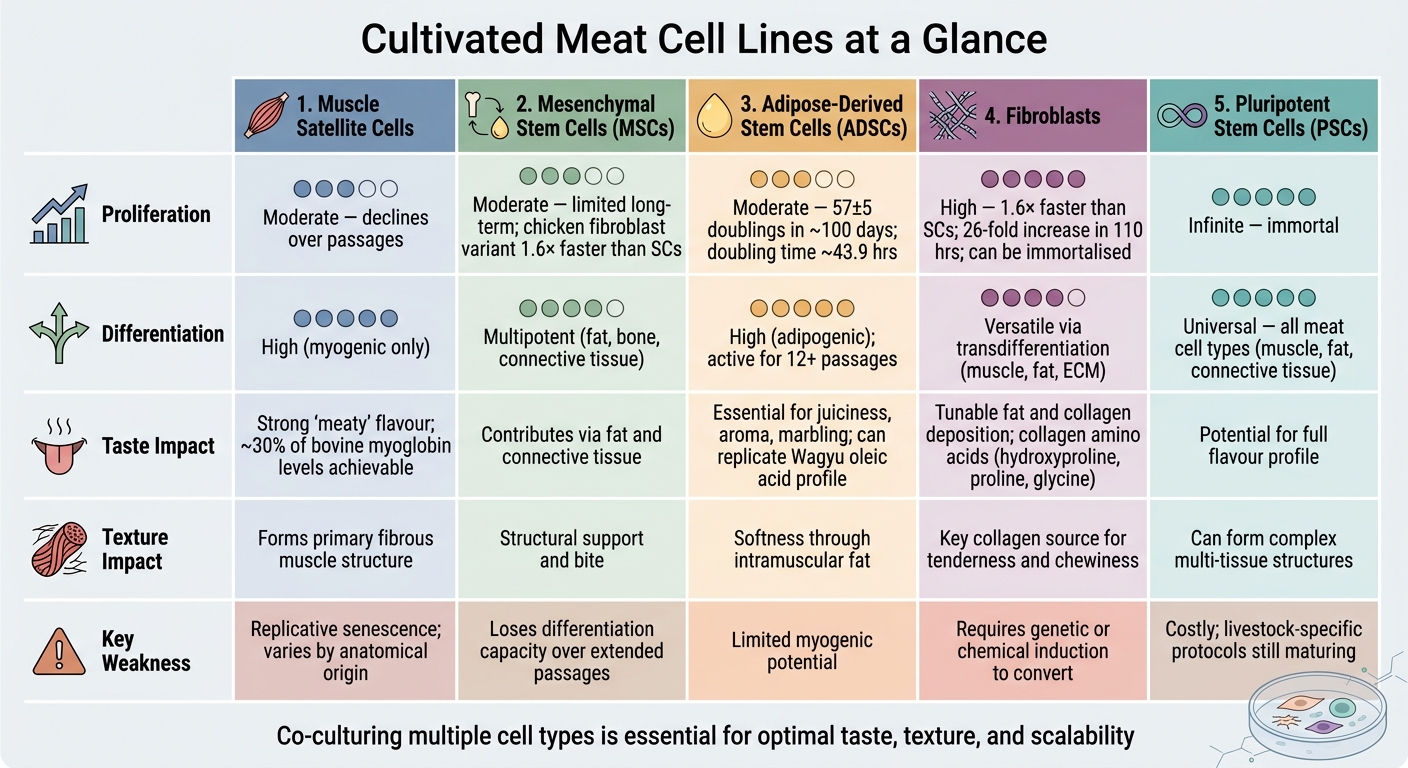
Cultivated Meat Cell Lines: Proliferation, Differentiation & Sensory Impact Compared
Each cell line discussed in this article offers unique advantages and challenges, making them suitable for different aspects of cultivated meat production. The table below breaks down how each cell type performs across four key factors: proliferation, differentiation, taste, and texture, while also highlighting their main limitations.
| Cell Line | Proliferation | Differentiation | Taste Impact | Texture Impact | Key Weakness |
|---|---|---|---|---|---|
| Muscle Satellite Cells | Moderate - declines over passages [2][5] | High (myogenic) | Strong "meaty" flavour and robust protein character [2] | Forms the primary fibrous muscle structure [5] | Replicative senescence; performance varies by anatomical origin [5] |
| Mesenchymal Stem Cells | Moderate - limited in long-term culture [2] | Multipotent (fat, bone, connective tissue) [2] | Contributes via fat and connective tissue [2] | Provides structural support and bite [2] | Difficult to isolate; loses differentiation capacity over extended passages [2] |
| Adipose-Derived Stem Cells | Moderate [1] | High (adipogenic) [1] | Essential for juiciness, aroma, and marbling [1] | Provides softness through intramuscular fat [1] | Limited myogenic potential [1] |
| Fibroblasts | High - can be immortalised [8] | Versatile via transdifferentiation [8] | Tunable fat and collagen deposition [8] | Key source of collagen for tenderness [8] | Requires genetic or chemical induction to convert into muscle or fat [8] |
| Pluripotent Stem Cells | Infinite - immortal [2] | Universal - potential for all meat cell types [2] | Potential to achieve a full flavour profile [2] | Can form complex, multi-tissue structures [2] | Costly; livestock-specific protocols are still maturing [2] |
The table provides a concise overview, but let’s delve deeper into how these characteristics play out in cultivated meat production.
Muscle satellite cells are often considered the benchmark for replicating the texture of muscle, thanks to their ability to form fibrous structures. However, their limited proliferation over time and variability based on anatomical origin can complicate scalability. Fibroblasts, on the other hand, excel in scalability because they can be immortalised, but they require specific interventions to transform into functional muscle or fat tissue.
Adipose-derived stem cells (ADSCs) are indispensable for producing the fat that gives meat its juiciness and aroma. While they fall short in generating muscle tissue, combining them with muscle satellite cells can overcome this drawback. Pluripotent stem cells stand out for their versatility, capable of differentiating into all necessary meat cell types. Yet, their high cost and the need for species-specific protocols make them a challenging option for large-scale production.
The anatomical origin of these cells also plays a vital role. It directly affects their ability to proliferate, produce proteins, and form myotubes, all of which have a significant impact on the scalability and texture of the final product [5].
"Variability in SC proliferation and differentiation abilities affects not only the efficiency of cultivated meat production but also the texture of the meat, as it is determined by muscle fiber composition patterns." - npj Science of Food [5]
Ultimately, no single cell type can meet all the demands of cultivated meat production. Instead, producers rely on co-culturing multiple cell types to achieve the right balance of flavour, texture, and scalability. This integrated approach is essential for advancing cultivated meat development and ensuring a high-quality end product.
Conclusion
Choosing the right cell lines is central to creating cultivated meat that mimics the taste and texture of traditional meat. Muscle cells bring structure and chew, fat cells add juiciness and flavour, while connective tissue delivers tenderness. Achieving the full sensory experience of meat means combining these cell types effectively, which is why the most advanced products rely on multiple cell lines working together.
Beyond the biology, how cells are nourished plays a key role. Adjusting the feed during cultivation can enhance both aroma and nutritional content, presenting a unique advantage over conventional meat production:
"An important potential advantage of cultivated meat technology is in the ability to tailor aroma and nutritional content during cell cultivation due to the direct access of the media to the cells." - Frontiers in Nutrition [4]
These cellular decisions not only shape the quality of the meat but also affect how soon products can reach the market. For UK consumers, this has practical significance. As previously discussed, scalable cell lines like pluripotent stem cells are more likely to make cultivated meat accessible and affordable sooner than those relying solely on muscle satellite cells. Additionally, hybrid products that combine cultivated cells with plant-based scaffolds could be the first widely available options in the UK, offering an easier introduction to understanding cultivated meat.
For updates on product types, sensory characteristics, and availability in the UK, visit Cultivated Meat Shop to explore this exciting new frontier in food.
FAQs
Why do cultivated meat makers mix muscle, fat and connective-tissue cells?
Cultivated meat producers blend muscle, fat, and connective-tissue cells to mimic the taste, texture, and structure of traditional meat. Muscle cells form the primary structure, fat contributes to flavour, juiciness, and texture, and connective tissues enhance the overall mouthfeel and ensure firmness. This careful combination results in an alternative that closely resembles conventional meat. At Cultivated Meat Shop, we delve into these advancements driving the evolution of cultivated meat.
How does a cell’s anatomical source change taste and texture?
The type of cell used in cultivated meat plays a massive role in shaping its taste and texture. Cells like muscle, fat, or connective tissue each come with their own unique set of proteins, fatty acids, and aromatic compounds. These elements are what give meat its distinct flavour and structure. By carefully selecting and working with specific cell types, producers can recreate the sensory experience of traditional meat.
The Cultivated Meat Shop dives into how these scientific breakthroughs are reshaping the way we think about food and its future.
Can producers tune marbling and aroma through the growth medium?
Producers have the ability to fine-tune both marbling and aroma in cultivated meat by tweaking the growth medium. For marbling, adding fatty acids and insulin encourages muscle cells to form lipid droplets, mimicking the fat distribution found in traditional meat. To enhance aroma, specific nutrients like thiamine, L-methionine, or myoglobin can be included. These additions help generate volatile compounds that release savoury, milky, or even fruity aromas when the meat is cooked.


