

Cultivated meat - grown from animal cells instead of farm-raised livestock - offers a way to produce meat with reduced greenhouse gas emissions and resource use. While Asia is moving quickly to integrate this technology, following an accelerated roadmap for cultivated meat, Europe faces slower progress due to stricter regulations and sceptical consumers.
- Asia: Singapore leads approvals, with products like cultivated chicken and quail already on the market. China supports the sector through its national policy, and consumer interest is high, driven by food security concerns.
- Europe: Regulatory hurdles under the EU’s Novel Food framework delay approvals by up to five years. The UK has made small advances, but widespread adoption remains limited due to consumer distrust and resistance tied to preserving traditional food practices.
Quick Comparison
| Criteria | Europe | Asia |
|---|---|---|
| Market Size (2024) | $80.84m | $179.0m |
| Growth Projection | $276.68m by 2033 (CAGR: 14.65%) | $510.7m by 2033 (CAGR: 12.3%) |
| Regulatory Speed | Slow (3–5 years for approval) | Faster (case-by-case evaluations) |
| Consumer Openness | Lower (32% distrust food tech) | Higher (e.g., 60% in India) |
| Key Players | UK, Netherlands, Germany | Singapore, China, South Korea |
Asia's supportive policies and consumer interest position it as a leader, while Europe’s cautious approach slows progress.
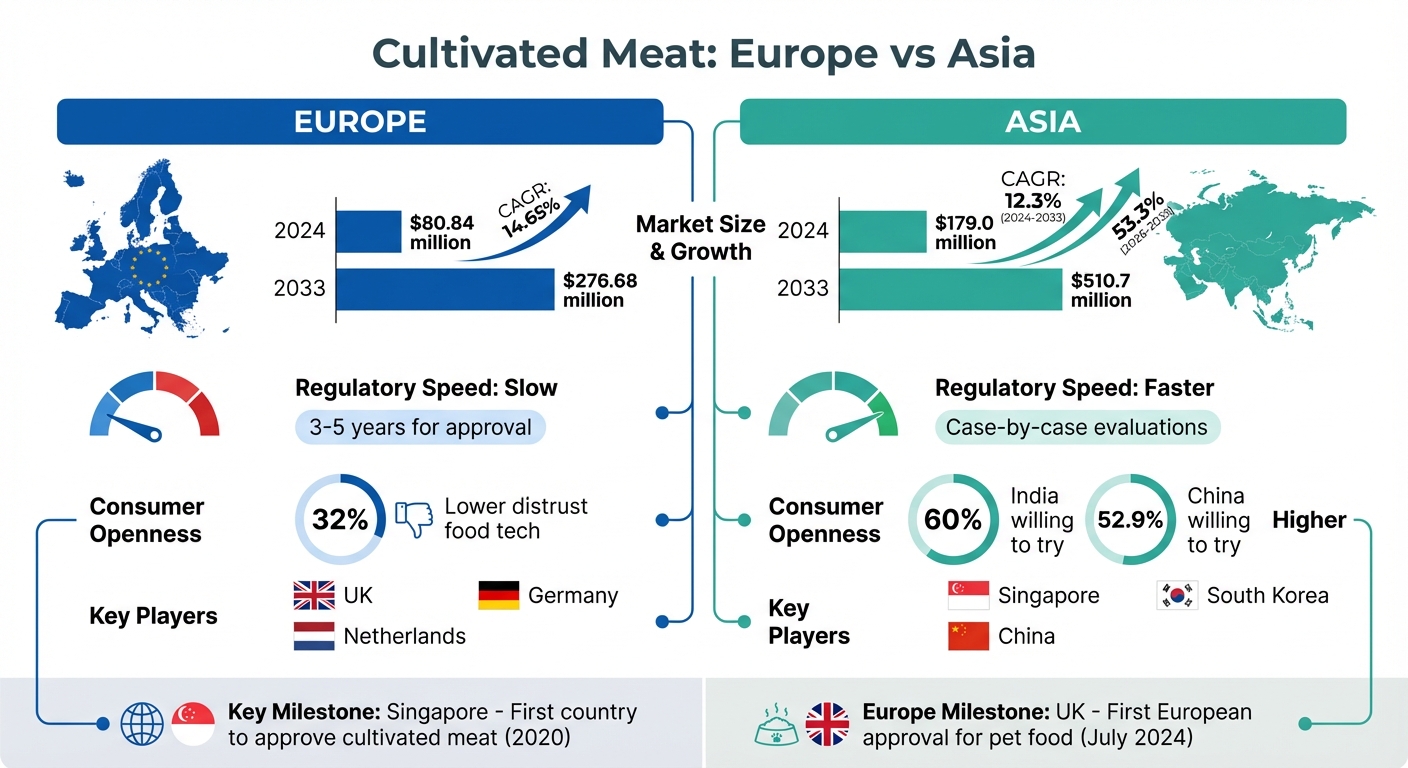
Europe vs Asia Cultivated Meat Market Comparison 2024-2033
Market Size and Growth: Europe vs Asia
Europe's Market Size and Adoption Trends
In 2024, Europe’s Cultivated Meat market was valued at $80.84 million, with projections suggesting it could grow to $276.68 million by 2033, marking a compound annual growth rate (CAGR) of 14.65% [7]. The UK, Germany, and the Netherlands are leading the charge in this sector. Notably, the UK became the first European country to grant regulatory approval for Cultivated Meat in 2024, although this approval was limited to the pet food market [10].
One standout example is the UK-based company Meatly, which achieved Europe’s first regulatory approval for Cultivated Meat in the pet food sector in 2024. By February 2025, Meatly launched a cat wet food product featuring 4% cultivated chicken, priced at approximately £69.80 per kilogram [10]. Meanwhile, Mosa Meat, a Dutch company, secured €40 million in funding in 2024, marking the largest single European investment in the sector since 2022. This funding aims to support market entry and scaling efforts. This involves complex cultivated meat production processes to reach commercial viability. Poultry remains a dominant category in Europe, accounting for about 36% of the market, largely due to its lower production costs and familiarity among consumers [7].
Interestingly, over half of consumers across 13 EU countries have expressed consumer acceptance of cultivated meat. However, strict Novel Food regulations and strong ties to traditional farming practices have somewhat slowed progress [7][10].
Asia's Market Size and Adoption Trends
Asia’s Cultivated Meat market is growing at a different pace, driven by innovation and robust government backing. In 2024, the Asia-Pacific market was valued at $179.0 million - more than double Europe’s - and is expected to reach $510.7 million by 2033, with a CAGR of 12.3% from 2024 to 2033. Notably, growth between 2026 and 2035 could reach an even higher CAGR of 53.3% [8][9]. Key players in this region include Singapore, China, and South Korea, with Singapore taking the lead in commercial approvals. China has also integrated Cultivated Meat into its 14th Five-Year Agricultural Plan, launched in 2022 [6][9].
Singapore has been a trailblazer in this space. In May 2024, GOOD Meat, a division of Eat Just, achieved a global milestone by initiating the first-ever retail sale of Cultivated Meat at Huber’s Butchery. Their product, "GOOD Meat 3", contains 3% cultivated chicken and promises the taste and texture of conventional meat at a reduced price [9][10]. Similarly, the Australian company Vow entered the market in April 2024 with its "Forged" brand of cultivated quail parfait in Singapore, later gaining regulatory approval in Australia by June 2025 [10].
Asia’s rapid expansion is fuelled by concerns over food security, high population density, and active government involvement. Consumer interest is also strong, with surveys showing that 60% of Indian consumers and 52.9% of Chinese consumers are willing to try Cultivated Meat [9][10]. Globally, poultry and seafood are key categories, together making up around 41% of the market share [10].
sbb-itb-c323ed3
Regulatory Frameworks and Policies
Europe's Regulatory Approach
In the European Union, Cultivated Meat is classified as a Novel Food under Regulation 2015/2283. This means it must undergo a pre-market safety assessment by the European Food Safety Authority (EFSA), followed by a political vote from EU member states [11]. Although the process is officially set to take 18 months, it can stretch to three years if EFSA requests additional data [11].
This extended timeline poses significant challenges for startups. Daan Luining, CTO and co-founder of Meatable, highlighted this issue:
"Most of the experts or people that have been through such a process before told us that it could easily take up to three to five years [for approval in Europe], and that's a cash burn I cannot overcome" [4].
As a result, many European companies have opted to launch their products in markets like Singapore and the US, where approval processes are more streamlined.
Adding to the delays is political resistance. In December 2023, Italy enacted Law n. 172/2023, which outright bans the production and sale of Cultivated Meat to safeguard its "gastronomic heritage" [11]. By early 2024, 14 EU countries, including France and Austria, had signed a note voicing concerns about the safety and ethical aspects of this technology [11]. By 2025, only one application - submitted by French company Gourmey for cultivated foie gras - had been filed with EFSA [11].
Post-Brexit, the UK has taken a different route. The Food Standards Agency introduced a "regulatory sandbox", offering pre-application support for Cultivated Meat products to address safety and scalability issues before formal submission [3][4]. This approach bore fruit in July 2024, when UK-based Meatly achieved Europe's first limited approval for cultivated pet food [3][4].
Asia's Regulatory Approach
In contrast to Europe's slower processes, Asia has embraced a more agile regulatory stance. Singapore leads the way with a case-by-case evaluation framework that prioritises early dialogue between producers and the Singapore Food Agency (SFA) [5][12]. This collaborative method has enabled quicker approvals - Singapore was the first country to greenlight Cultivated Meat for sale back in 2020 [12]. By February 2026, the SFA had approved three products: Good Meat's cultivated chicken, Vow's cultivated quail, and Parima's cultivated chicken [3].
Anthony Chow of Agronomics emphasised the stark difference between regulatory environments:
"There is proof that you can get products approved in Singapore and in the US - there is no evidence that you can in Europe. So why would you bear that additional risk?" [4]
Japan is also emerging as a key player in Asia, blending a rigorous safety focus with a forward-thinking attitude. Suzi Gerber, Executive Director of AMPS Innovation, remarked:
"Japan has done quite a bit of very robust safety analysis... They're extremely tech-accepting, but also famously rigorous when it comes to safety" [3].
These varied regulatory approaches have a direct impact on costs and scaling. The lack of global alignment can drive up approval expenses for companies by as much as 30% [12]. Additionally, 75% of cultivated meat companies cite inconsistent international rules and data protection as major barriers to growth [12].
Consumer Attitudes and Barriers
European Consumer Attitudes
In Europe, many consumers perceive Cultivated Meat as both "unnatural" and overly processed. Durk Bosma, Head of Insights at EIT Consumer Observatory, summed up the scepticism with this observation:
"Consumers can't really imagine that something that lives in a petri dish could become similar to a steak." [13]
This hesitation is especially pronounced in countries like France, Italy, and Germany, where traditional culinary practices often clash with the concept of food technology [2]. While these concerns act as a major hurdle, animal welfare remains a powerful motivator. Over 40% of vegans and vegetarians in Europe are open to trying Cultivated Meat, primarily because it eliminates animal suffering [6]. Still, 32% of European consumers express distrust in the science and companies behind food tech innovations [2].
| Factor | European Consumer View |
|---|---|
| Primary Driver | Animal welfare and ethical considerations [13] |
| Main Barrier | Perception of being "unnatural" and heavily processed [13] |
| Distrust Level | 32% sceptical of food tech companies and science [2] |
| Openness | Below global average, particularly in France, Italy, and Germany [2][13] |
Asian Consumer Attitudes
In contrast, consumers in Asia show a much higher level of openness towards Cultivated Meat [13]. Malaysia, for instance, reports 26% of its population willing to try it [2]. Tom Rees, Industry Manager at Euromonitor International, highlighted Asia's leadership in this space:
"Overall, it is Asia that leads the way, and perhaps China holds the greatest potential." [6]
Food security plays a central role in this acceptance. When China included Cultivated Meat in its Five-Year Plan in January 2022, it signalled strong governmental support, which has positively influenced consumer attitudes [6]. This top-down endorsement has created a favourable environment for innovative food solutions. Additionally, concerns about food safety resonate more strongly in Asia, where 31% of consumers see it as a motivator, compared to just 21% in Europe [2]. Flora Zwolinski, Senior Insight Manager at Lumina Intelligence, noted:
"Asian regulatory environments likely have less red tape... consumers in Asian markets show a greater acceptance and culture of adopting technology to benefit the nation." [2]
While government backing and a tech-friendly mindset drive adoption, challenges remain. Cost and taste are common sticking points, with many consumers doubting whether Cultivated Meat can truly replicate premium cuts like steak [13][6]. Globally, certain demographic trends hold steady: younger adults, men, and those with higher education or income levels are more inclined to try Cultivated Meat [13][6].
As Cultivated Meat continues to develop, platforms like Cultivated Meat Shop aim to bridge the knowledge gap by providing clear, accessible information. Whether in Birmingham or Beijing, these resources can help consumers understand how this emerging food fits into their lives. These differing attitudes highlight the varied paths this technology might take in different regions.
Lab-grown meat: Why are countries banning it? - The Global Story podcast, BBC World Service
Future Outlook and Growth Projections
The future of cultivated meat reveals contrasting trajectories for Europe and Asia, shaped by market trends and regulatory landscapes.
Europe's Path to Mainstream Adoption
Europe's journey toward mainstream acceptance of cultivated meat remains uncertain. As of early 2026, the European Food Safety Authority (EFSA) has yet to approve any cultivated meat products for human consumption, prompting some startups to pivot towards Asian and U.S. markets for initial revenue opportunities [4]. Anthony Chow, Partner at Agronomics, highlighted the challenge:
"There is no evidence that you can get products approved in Europe." [4]
This regulatory sluggishness mirrors earlier obstacles and persistent consumer scepticism in the region. However, Europe does have some advantages. In 2022, the Dutch government allocated €60 million to develop a national cellular agriculture ecosystem - the largest investment of its kind by any national government [1]. Projections indicate that the European cultivated meat market could grow at a compound annual growth rate (CAGR) of 14.65% from 2025 to 2033 [7]. The UK has also shown progress, becoming the first European nation to approve cultivated meat for sale in July 2024 by authorising Meatly's cultivated chicken pet food [3].
Despite these advancements, cultural resistance poses a significant challenge. Countries like Italy, Hungary, and Romania have introduced or proposed bans to safeguard culinary traditions and conventional agriculture [18]. Industry experts caution that Europe's slow pace may undermine its global competitiveness. As one report bluntly stated, "At the current rate, Europe will have to settle for dishing out seconds" [14]. Compared to Asia's rapid expansion, Europe's cultivated meat market remains relatively modest [14].
Asia's Path to Mainstream Adoption
Asia, on the other hand, is accelerating towards market dominance, thanks to streamlined regulations and robust government support. Singapore set the stage by approving its first cultivated meat product in December 2020. By 2026, companies like Good Meat, Vow, and Parima had also gained regulatory approval [3]. China further solidified its commitment by including cultivated meat in its Five-Year Plan in January 2022 [6]. The Asia Pacific region is projected to see the fastest growth globally, with an estimated CAGR of 52.9% between 2023 and 2030 [15], and by 2050, it could account for 38% of the global cultivated meat market share [17].
Asia's vast population and food security challenges make cultivated meat a strategic solution to rising protein demands. For instance, Avant Meats Company Limited secured significant Series A funding in June 2022 to scale cultivated seafood production, addressing issues like overfishing and the sustainability of marine ecosystems [15][16]. Cultivated seafood, in particular, is emerging as a high-growth area within the region [15].
Technological advancements are also playing a crucial role. India is becoming a hub for integrating AI and biotechnology to improve cell-line development and reduce production costs [16]. Vidyesh Swar, Principal Consultant at Towards FnB, noted:
"AI is fundamentally transforming how cultivated meat moves from lab-scale experimentation to industrial-scale production." [16]
Globally, the AI market in cultivated meat is expected to reach $573.45 million by 2035 [16]. Tom Rees, Industry Manager at Euromonitor International, underscored Asia's leadership:
"Overall, it is Asia that leads the way, and perhaps China holds the greatest potential." [6]
While mainstream adoption might not occur until the latter half of the 2040s, Asia's supportive policies, consumer receptivity, and technological investments position it as a global leader. For UK consumers intrigued by these developments, platforms like Cultivated Meat Shop provide resources and early product previews as the industry evolves.
Conclusion
Europe trails behind Asia in the development of cultivated meat, with Asia - led by Singapore - taking the lead. Singapore has positioned itself as a global pioneer, achieving multiple regulatory approvals and prioritising food security as part of its strategy. Meanwhile, China's inclusion of cultivated meat in its Five-Year Plan highlights a strong political commitment that is expected to accelerate growth in the sector [6].
In contrast, Europe faces hurdles from both regulatory caution and consumer scepticism. While Asia progresses rapidly, Europe remains stalled, with countries like Italy and France introducing bans to protect culinary traditions. Several factors shaping cultivated meat acceptance, including distrust of food technology, are more prevalent in Europe, with 32% expressing scepticism compared to 24% in Asia [2]. A small breakthrough came in July 2024 when the UK approved Meatly's cultivated chicken pet food. However, broader regulatory uncertainty continues to hinder progress. As Anthony Chow, Partner at Agronomics, put it:
"I don't see any light at the end of the tunnel for Europe from a regulatory standpoint. There is proof that you can get products approved in Singapore and in the US - there is no evidence that you can in Europe." [4]
Consumer attitudes further illustrate this divide. In Malaysia, 26% of people say they would probably or definitely consume cultivated meat. In contrast, interest is much lower in France, Italy, and Germany [2]. For many Asian consumers, cultivated meat represents advancements in food hygiene and national progress, whereas Europeans tend to prioritise "natural" and traditional foods [2]. This cultural gap has driven European startups to focus on Asian markets as a way to generate early revenue.
FAQs
When will Cultivated Meat be approved for consumption in Europe?
Cultivated meat could become a reality for European consumers by 2027, pending approval for human consumption. In the UK, the Food Standards Agency is collaborating with companies to ensure all necessary safety evaluations are completed within this timeline. Efforts are well underway to bring this forward-thinking food choice to the market.
Why is Singapore approving cultivated meat faster than the EU?
Singapore has outpaced the EU in approving cultivated meat, thanks to its streamlined regulatory framework, government-backed investments, and emphasis on food security. The Singapore Food Agency typically processes applications within 9–12 months, offering a much quicker timeline compared to the EU's slower, more intricate procedures involving detailed guidelines and risk assessments. Beyond regulatory efficiency, Singapore has committed over £180 million to infrastructure supporting this sector. In contrast, the EU's cautious stance and preference for natural food traditions contribute to its slower progress.
Will cultivated meat ever be affordable compared with conventional meat?
Recent developments show that cultivated meat is steadily becoming more affordable, edging closer to the cost of conventional meat. Key breakthroughs in scaling production, automation, and culture media have played a big role in slashing production expenses.
Currently, prices are nearing parity with traditional meat options. And with ongoing advancements in bioreactor technology and supply chain efficiency, costs are expected to drop even further. As the market expands and these technologies mature, cultivated meat is shaping up to be a budget-friendly alternative for consumers.


