

If shoppers do not know what a product is in seconds, many will not buy it. That is the main problem here: mixed names, loose claims, and missing basics make cultivated meat harder to judge than it should be.
From what I see in the article, the fix is simple:
- Use one name: Cultivated meat
- Say what it is: Real meat grown from animal cells
- Avoid vague claims: swap words like eco-friendly or healthier for plain facts
- Put key details first: safety, taste, approval status, allergens, and price
- Cut jargon: terms about production can make people stop reading
One stat stands out: 56% of consumers shown specific sustainability information had a positive view, compared with 47% who were not shown it. That gap suggests a plain, specific claim can help more than a broad slogan.
I’d sum it up like this: people are not only unsure about the product itself. They are also unsure because the wording often makes it sound vague, science-heavy, or hard to place. If brands say less, but say it more plainly, first-time buyers have less guesswork and more confidence.
What Is Going Wrong in Current Cultivated Meat Messaging
The problem is not lack of interest. It is messaging that leaves shoppers unsure at the exact moment they need clarity.
Mixed Terminology Makes the Same Product Sound Different
Cultivated Meat still shows up under several names, so people seeing it for the first time may not realise those labels point to the same product. [2][1]
That confusion gets worse when the language turns technical. Terms linked to production details, such as bioreactors, scaffolding, and cell lines, can make Cultivated Meat seem unnatural or off-putting, especially for people who are already cautious about new food tech. [1]
On top of that, uneven labelling can blur the category itself. Shoppers may mix up Cultivated Meat with plant-based products or fermentation-derived proteins, and then they are left wondering what they are actually buying. [2]
Vague Health and Sustainability Claims Create More Guesswork
Big claims about health and sustainability do not do much on their own. If they do not spell out what has been shown and what has not, shoppers are left to fill in the gaps. [1]
That is where trust starts to slip. A claim can sound good, but if the proof is not clear, it can also sound vague or hard to believe. [1]
"The challenge new food technology faces is that most consumers have limited knowledge about it, which impedes the proper judgement of both the benefits and risks associated with it." - MDPI [1]
When people cannot size up the benefits and the risks at a glance, the product becomes harder to trust.
Missing Basics Leave First-Time Shoppers Uncertain
First-time shoppers are usually looking for the basics first: [safety, allergen details, taste, texture, and price](https://cultivatedmeat.co.uk/blogs/cultivatedmeat/cultivated-vs-traditional-meat-decision-guide). When that information is not easy to find, it becomes much harder to decide whether Cultivated Meat is worth a try. [2]
And when those basic answers are missing, hesitation tends to show up right at the point of purchase.
sbb-itb-c323ed3
How Confusing Claims Slow Adoption
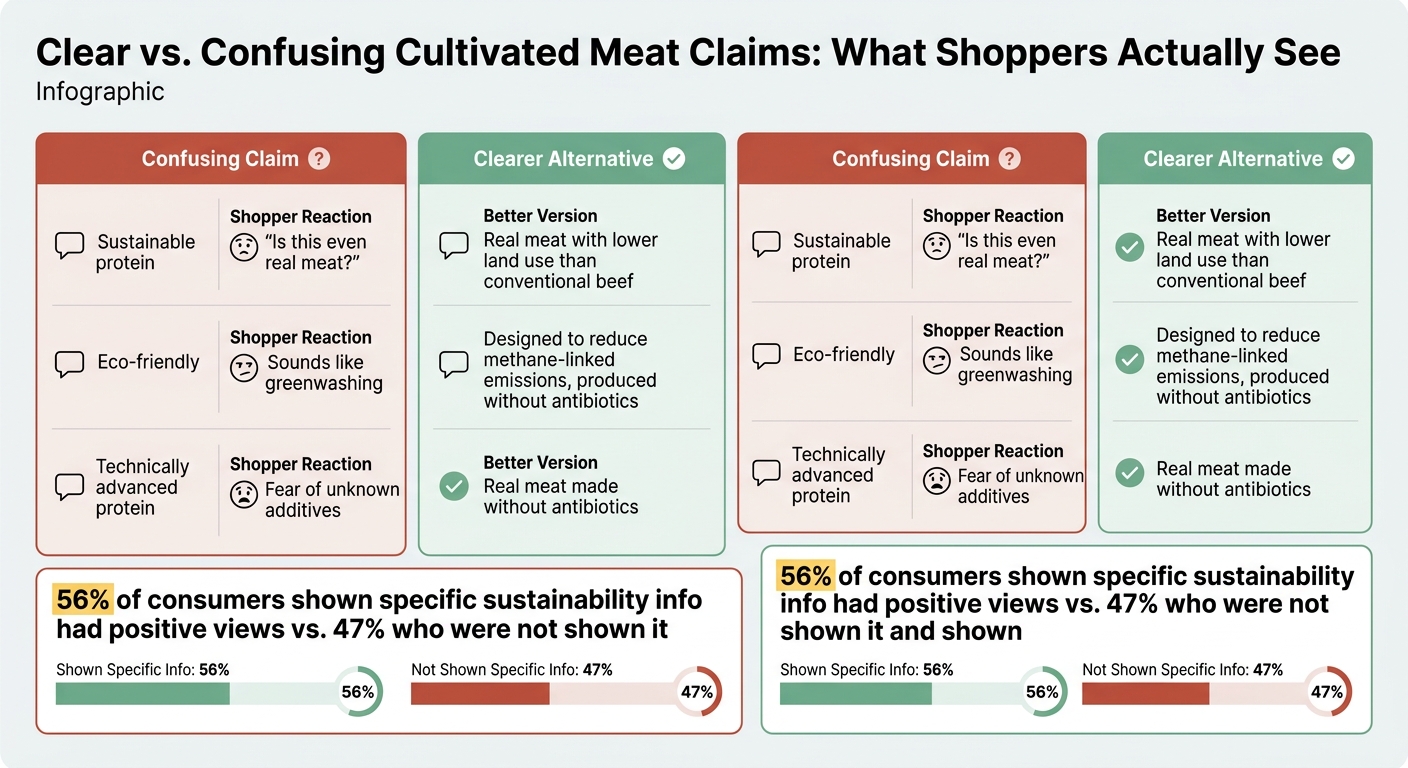
Clear vs. Confusing Cultivated Meat Claims: What Shoppers Actually See
Unclear Labels Increase Doubt and Reduce Willingness to Try
Novel foods face a trust gap straight away. Cultivated Meat is still new to many shoppers, so the label shapes that first reaction in seconds. The right wording can calm uncertainty. The wrong wording can spark doubt.
Production jargon makes Cultivated Meat feel harder to approach [1]
"The perception of unnaturalness can evoke a sense of disgust or uneasy feelings, inhibiting the acceptance of cultivated meat." - Wei Fu et al., Sustainability Journal [1]
And for many people, that uneasy feeling is enough to stop a first purchase. Once doubt creeps in, they stop reading and move on.
Poorly Defined Claims Can Backfire After First Impressions
That hesitation gets worse when claims sound big but mean little. Broad claims may catch the eye, but clear claims give people a reason to stay with the product. If “sustainable” isn’t explained, shoppers often read it as vague marketing. Specific claims build trust. Broad ones usually don’t.
A U.S. nationwide survey found that 56% of consumers shown specific sustainability information had positive preferences for Cultivated Meat, compared with 47% of those who were not shown such information [1]. That gap matters. It shows that detail, not slogans, shifts preference.
Comparison Table: Clear Claims Versus Confusing Claims
The contrast shows up in the wording itself.
| Claim or wording | What shoppers may assume | Likely reaction | Clearer alternative |
|---|---|---|---|
| "Sustainable protein" | It is a generic protein product, not real meat | Disappointment if they wanted real meat | "Real meat with lower land use than conventional beef" |
| "Eco-friendly" | Vague greenwashing without proof | Scepticism and ignoring the claim | "Designed to reduce methane-linked emissions, produced without antibiotics" |
| "Technically advanced protein" | High-tech processes with unknown long-term health risks | Fear of unknown additives | "Real meat made without antibiotics" |
That’s why precise wording matters at the point of sale. Clear, specific language removes friction before shoppers lose interest. The goal isn’t more claims. It’s clearer ones.
Simple Fixes Brands and Retail Platforms Can Use
Use One Consistent Name and Add a Plain-Language Explanation
These fixes are simple, but they matter right at the point of sale.
Pick one name and stick with it. Cultivated Meat is the clearest term to use, and using it across packaging, product pages, and educational content helps shoppers get familiar with it faster [1]. Every extra label adds more friction, making it harder to understand cultivated meat labels.
Next to the name, add one short clarifier in plain English. "Real meat grown from animal cells, not slaughter" does that in under ten words. It tells people what the product is and why it matters, without making them work through a science lesson first.
Replace Broad Promises with Specific, Scoped Statements
Swap "eco-friendly" for "lower land and water use than conventional meat" and the claim becomes far easier to trust [1]. The same goes for health messaging. Instead of saying "a healthier choice", say "produced without antibiotics or growth hormones" - a factual statement that can be checked and understood at a glance [1].
Use technical terms only when they help the shopper.
Animal welfare claims need the same kind of care. "Cruelty-free" can feel woolly. "Grown from cells without slaughter" is much clearer [1].
Give Shoppers the Details They Look for First
On e-commerce pages and product labels, order matters just as much as the wording. First-time shoppers tend to look for four things straight away:
- What it is
- How it tastes
- Whether it is approved for sale
- What allergens it contains
If any of that is buried, the decision gets slower.
Short, easy-to-scan information blocks work well here. A product listing might start with "Real beef grown from cells - cooks and tastes like traditional mince", then move straight into allergen details in line with conventional meat labelling [3]. That kind of clarity helps the shopper move on to the next choice without second-guessing.
Cultivated Meat Shop uses the same plain-language approach to help shoppers learn the basics before they buy.
Conclusion: Clearer Wording Can Remove Avoidable Barriers
Unclear wording gets in the way of Cultivated Meat adoption in the UK. When different terms are used for the same kind of product, it can sound as though shoppers are looking at several different things instead of one. On top of that, loose claims such as "eco-friendly" or "a healthier choice" can leave people thinking: What does that mean in practice? If the basics are missing, what it is, how it tastes, and whether it is safe, many first-time buyers simply move on.
You can see that in consumer response as well. In one study, 56% of consumers shown specific sustainability information were more positive about the product, compared with 47% who were not [1]. That difference suggests first impressions are shaped, at least in part, by the words people see.
The answer is fairly simple: use clearer wording. Researchers recommend benefit-led wording and careful use of technical language to avoid put-offs [1].
For UK shoppers, that means plain naming, specific claims, and upfront product details that cut out guesswork. When Cultivated Meat is easier to assess, people can make up their minds with more confidence. Cultivated Meat Shop uses plain-language product information to help shoppers decide with confidence.
FAQs
Why does naming matter so much?
Naming matters because clear, consistent language helps build trust and supports adoption. When shoppers see mixed terms or dense technical jargon, they can feel confused and unsure.
Using the term Cultivated Meat makes the category easier to recognise. As Cultivated Meat Shop explains, clear, descriptive language helps people understand the product and feel more confident about buying it.
What proof should claims include?
Claims should rest on clear, checkable evidence. That matters even more for ethical and environmental statements, where vague wording can mislead people fast.
For animal welfare, stick to plain factual wording, and only use it when it’s accurate. If a product claim says something about how animals were kept, fed or handled, there should be records to back it up.
For environmental claims, add measurable detail. That could mean lower greenhouse gas emissions, lower water use, or lower land use. Best case, those figures are backed by peer-reviewed studies rather than broad marketing language.
It also helps to show where the proof comes from. Add sourcing details, traceability, and supporting records where possible, so people can see the basis for the claim instead of being asked to take it on trust.
What do first-time shoppers want to know first?
First-time shoppers want plain-English answers about Cultivated Meat and what they’re putting in their basket. They want to know how it’s made, how it differs from conventional meat, what the label is telling them, and whether it is safe, ethical and traceable.
In the UK, buyers also look for reassurance on health and food quality. Just as importantly, they want practical details they can check for themselves, such as the facility or location and the cell source.


